

A Purgatory Hammer
The kings of Trevelgue Cliff

The path from St Columb Minor skirts the valley side, only passes through fields on the way to Porth. Bill Pierce crosses the river, and makes the high cliff climb in his loose hand-me-down hobnailed boots. March has tipped over into a thunderous spring, too wet to drag a plough. Mr Copeland Borlase opens the barrows on the cliff today and they will pay for a day’s labour. There could be treasure found.
St Columba is aligned in the distance, like a pistol sight, with the two barrows standing proud on the cliff edge. You can hear the bells peal, and when they do, the jackdaws flutter about her spire. Bill Pierce was baptised in the cold drawn waters of her font, but the only water today is driven from the sea as horizontal rain. Mr Borlase does not speak to the boy, he measures the mound like a tailor, and then gives orders to the men. They crouch from the rain on the lee side of the seaward eastern barrow, drive their trench deep and open it from crown to apron.
The mound yields to the bite of Cornish spades and mattocks. Iron sparks off fist-sized quartz, and then they are down to brick red burnt earth. The cuffs of Bill Pierce’s smock are soon bloody with it. They will cart away several hundred loads to spread on the fields over the following week.
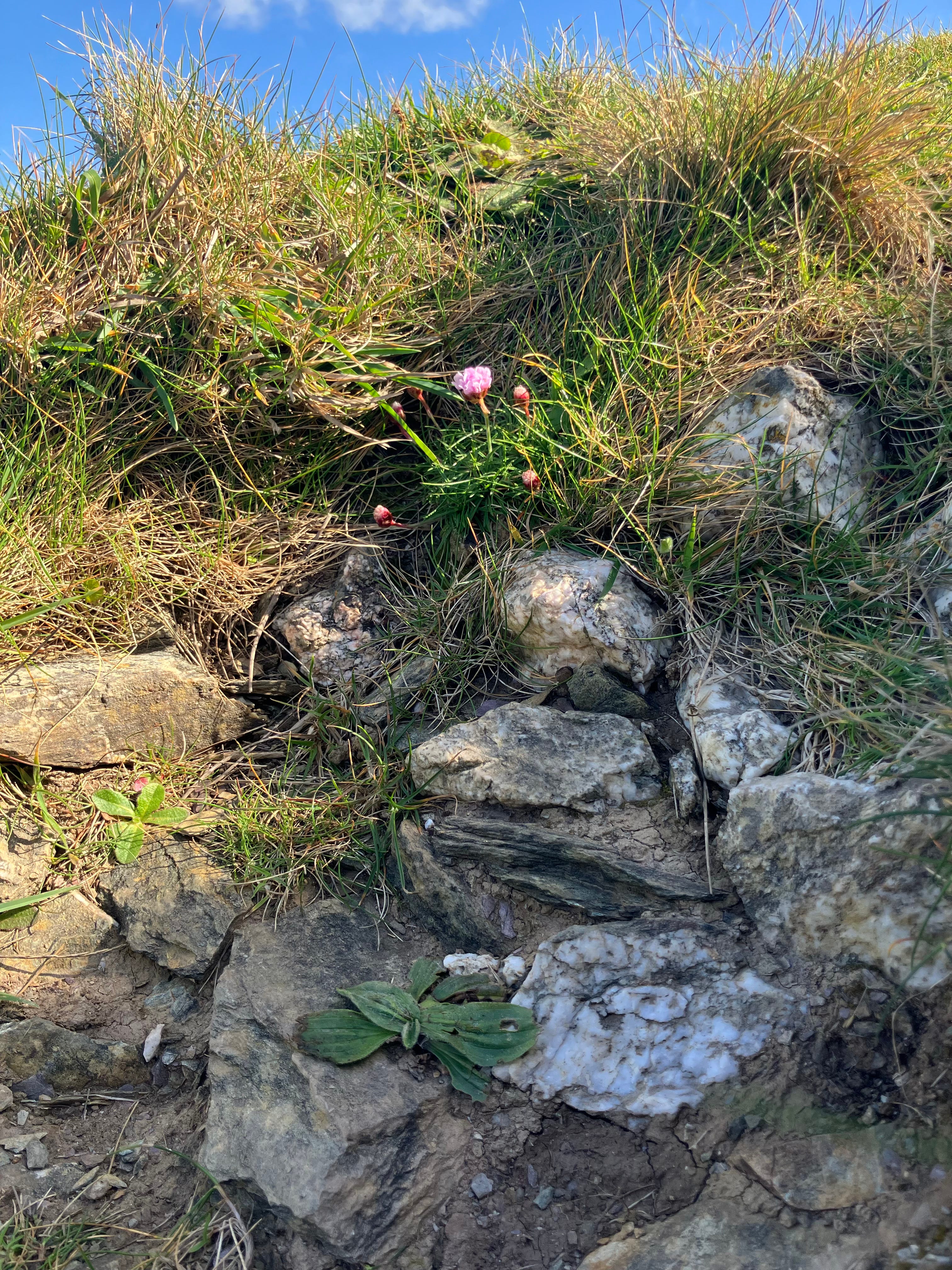
When they break for bread and cheese, the labourers talk and smoke. There is a piskey ring between the two mounds. One man points at it with his clay pipe. It returns year after year though the cattle trample through it. They say that if anything is placed in the circle after midnight, by morning it will be flung out. There is another over on the Barrowfields, a stain made by the blood of men who fought back to back until all were slain. Bill is very much taken by the tales, and the evidence of his own eyes that there are other truths in the land.1
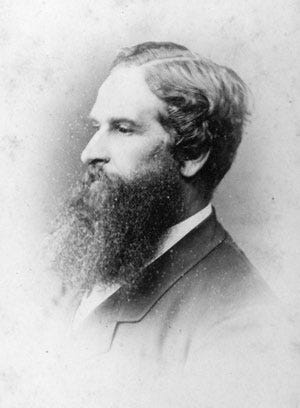
The gentlemen, Borlase, along with Charles Spence Bate and Richard Worth (who have come down from Plymouth), Captain Oliver, Reverend Iago, and not forgetting Sir John Evans, President of the Royal Society of Antiquaries, stand apart. They are deep in discussion. On the evidence of the red earth, they decide a fire on the barrow must have burned for weeks, perhaps months, undoubtedly fed with furze cut from the clifftop and sustained with hazel logs dragged up from the valley. This effort speaks to the importance of the individual interred.2 The beacon of fire would have lit the fishers from Porth, Towan Blystra and Crantock out harvesting the teeming pilchards, mackerel and the few longnose gar that didn’t slip through the nets. It will have teased the nostrils of the boys climbing nimble down the cliffs for speckled bird eggs. The column of smoke was visible as far north as Dinas Head, as far east as the Goss Moor and perhaps as far west as Bryanick. All would know what the beacon fire signified.
By mid-afternoon the men reach a cairn of long stones concealed in the mound, some twelve feet in diameter and four feet high. These too are marked with fire. Once the cairn is dissembled a great white stone gleams up, flush with the earth. Ten foot by six, this is the vast lid of the sanctum sanctorum.3
Mr Borlase leaps in there. The men are waved off with his hat, the boy cannot get near. Pace slows to patient work. Fingering round the kist, one of the thick slate slab supports is found to be cracked and an entrance made. The stones were expertly set, not a grain of earth had trickled into the void, the sentinel lay undisturbed for as many as 4000 years. His wool clothing and leather fastenings are now a soft brown mould in which thick bone fragments are cushioned. His skull, a broken casket. Evidently he was a strong man from the disarticulated osseous remains, but even here, time has found him out.
Borlase and the men are excited to find an inhumation, so unlike the urn burials in rude red Trevisker Ware of the nearby Newquay Barrowfields. It is a significant, and potentially much older site.4
Work resumes on Monday, March 11th, with attention turned to the second barrow. The first is left wrecked, as there is no material to repair it with, nor it seems, any will to do so. The relentless weather has begun to break, and Bill for one is glad of it. Though accustomed to raw hands and damp musty fustian, when the sky turns thrush egg blue his spirits lift. This time they sink straight down through the crown. Stones, then packed river clay make for hard going, but the lusty men swing and shovel. They strike up a chorus of Sweet Nightingale to accompany their work. At five feet deep they come to a secondary interment, mixed burned bone and ashes. They drive on. Beneath that is a great slate capstone running with quartz lightning. Many tons in weight, this earth fast dolmen cannot be breached from above. They dig around it and access the vault, a crawl space five feet by two. Again, the nimble Borlase is first in the tomb.
At the north-west the sleeper lays his head. He reposes on his left side with his knees drawn up. His gripped hands have felt the ash wood haft of his weapon perish. The skeleton crumbles at a touch, as if a spell has lifted. There on the slate pavement floor is the lone treasure of the barrow, an Elvan axe-hammer.5
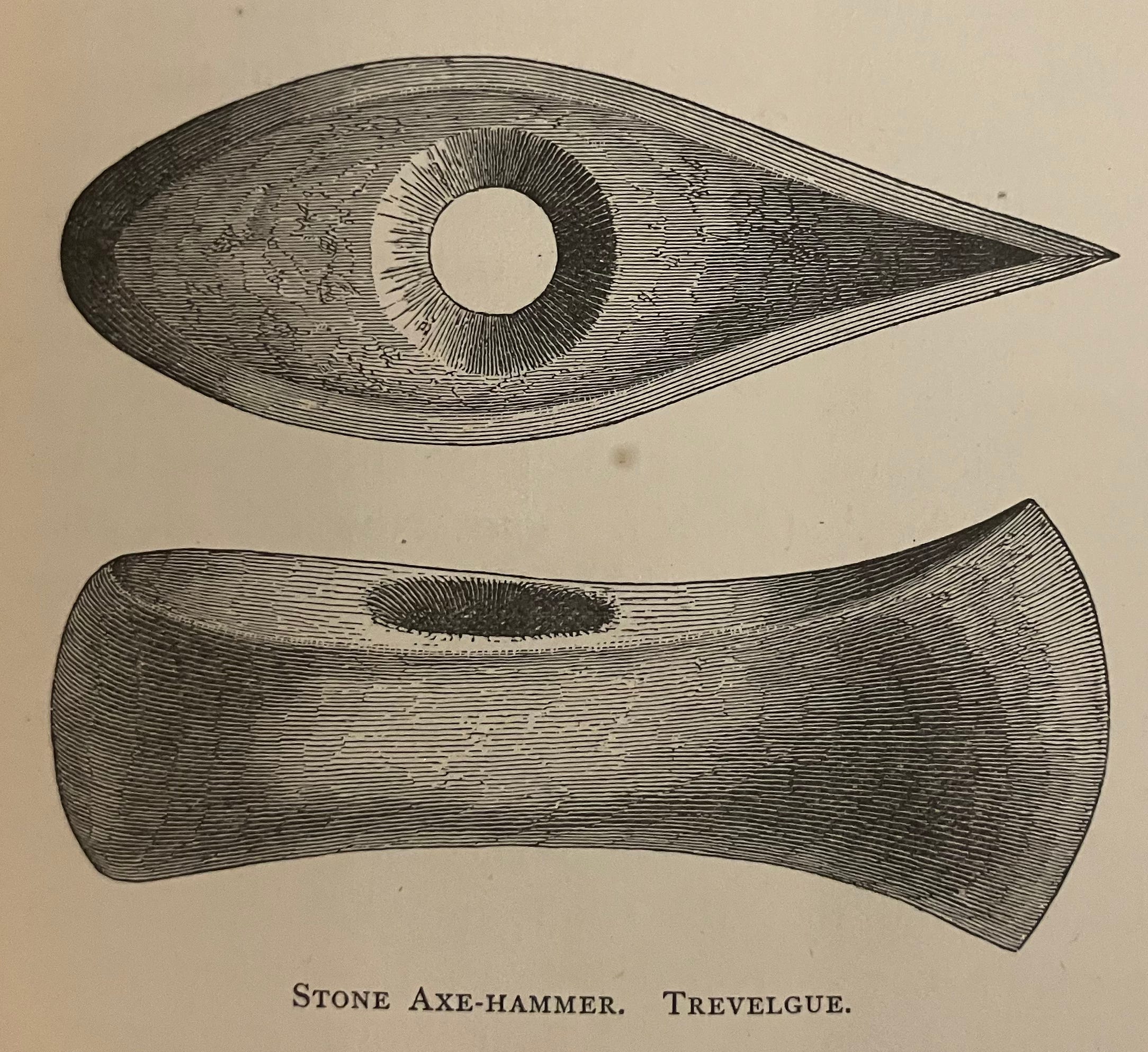
Borlase turns it in his wondering hands. When brought out into the light, the fine grained axe head, run through with schorl, glitters with quartz and flashes with feldspar.6 It is perforated, ground and polished. A perfect weighted form, thunder and lightning, the hammer and the splitting blade. At four inches long it seems a fairy weapon, though it could kill a man. He cannot be sure if it is truly ancient, Bronze Age, or even Norse, given the clifftop site.7 Bill Pierce presses forward, catches snatches of what the learned men are saying.
John Evans examines the axe too, remarks that they are common in Germany, sown in the fields and known as thunderstones. Whilst in Scotland, they call them purgatory hammers, with which the dead pagans beat on the heavenly gates for entry. He mimes with the axe. The gentlemen laugh at this, knowing, despite their faith, that the hammer has fallen through a great chasm of time, is no doubt older than the Christian religion. It is a rare and significant find in Cornwall.8 Evans mentions it in his grand grimoire of thunder weapons, The Ancient Stone Implements, Weapons and Ornaments of Great Britain, the first work of its kind.9 Borlase entrusts the find to Reverend Iago who wraps it in a cloth and shows it to the assembled labourers as if it were a child. At day’s end he takes it to be engraved by John Thomas Blight in the Bodmin Asylum, whose fine hand outlasts his mental acuity.
The sun begins to dip and the gentlemen pack up their Gunter’s chain and brass theodolite, close their notebooks. The only ritual left for them to perform is publication; they will not return here. The workers are left to backfill the barrow over the bones, and they rouse the final effort by singing Trelawney. A thin waxing crescent moon rises as Bill walks home to St Columb Minor.
Borlase includes the image, and describes the dig in rare detail, in his Noenia Cornubia. He keeps the find in his personal collection. There is an enigma to these graves he does not explore. Dominant on the cliff, those interred are likely kin, perhaps even father and son, but evidently two different rites have taken place. With no images, texts, songs or ceremonies, we have only the evidence of the fire, the axe, of earth, bones and stone. That, and the testimonies of one man and a boy, William and Bill, are all we have to follow if we wish to know the mysteries of the kings in their clifftop mounds.
When eventually summoned to beat upon the gates of heaven himself, William Copeland Borlase is a poor man. And though not as poor as Bill Pierce, he is bereft of honour, and must greet his Lord with empty penitent hands. Bankrupt and disgraced by scandal, his entire collection was sent to auction in 1887, only fifteen years after the dig. His body is confined beneath a grey granite ledger in Highgate Cemetery. The purgatory hammer rests in a drawer at the Museum of Archaeology and Anthropology in Cambridge with the other orphaned axes, celts, cores and microliths, dreaming of blood and thunder.
